Saturday, 14 December 2019

THE HERBAL PATH

Pharmacist specializing in natural remedies and alternatives to  
                                       prescription drugs.


Rungia repens
 http://phcogj.com/sites/default/files/1_14.jpg
 https://herbpathy.com/Uses-and-Benefits-of-Rungia-Repens-Cid6115


Alangium salviifolium

Alangium salviifolium

http://tropical.theferns.info/viewtropical.php?id=Alangium%20salviifolium


Elettaria+cardamomum

Elettaria cardamomum


http://tropical.theferns.info/viewtropical.php?id=Elettaria+cardamomum


Lawsonia+inermis

Lawsonia inermis

http://tropical.theferns.info/viewtropical.php?id=Lawsonia+inermis


Acacia+peregrinalis

Acacia penninervis (5368395701).jpg

http://tropical.theferns.info/viewtropical.php?id=Acacia+peregrinalis


Wednesday, 28 June 2017

THE SCIENCE OF ALCOHOL

......somewhere between confusion and stupor
                   Image result for oh alcohol

The 6 stages of getting drunk

. The jovial phase

Drinking less than half a glass of alcohol an hour is enough to suppress the functions of the frontal lobes which control your inhibitions, self-control, will power, ability to judge and concentration.
When this part of the brain is being suppressed you have fewer inhibitions, your self-confidence is boosted, you become more jovial and daring and you talk more - and louder. All of this explains why alcohol is considered an excellent social lubricant.
This effect can be detected at a blood alcohol level as low as 0,01 g/100 ml, which is easily reached by drinking less than half a glass an hour. It's way below the legal limit of 0,05 g/100 ml.
Believe it or not, at this stage your judgement is diminished and your personality has been sufficiently altered to increase your risk of dying an unnatural death - as a result of an accident or fight, for example.
Did you know?
If you party into the small hours and your head is spinning when you eventually crash into bed your blood alcohol content is about 0,2 g/100 ml - four times the legal limit. If you drive to work at 7 am the next morning and the traffic police pull you over you can be charged with driving under the influence. You don't have a hangover - you're still drunk!

 https://encrypted-tbn0.gstatic.com/images?q=tbn:ANd9GcQ7gU_WA5ycpKfmP3eYo6gqgVHieaILpnP5D2zRa9n6P4elsmbBEQ THE JOVIAL STAGE

.The slurring phase

Next in line to experience the alcohol wave are the parietal lobes at the sides and on the top of your head.
When your blood alcohol level is about 0,10 g/100 ml (typically after two to three drinks an hour) your motor skills are impaired. Your speech may be slurred but funnily enough you don't seem to notice.
Complicated movements such as buttoning your shirt or fastening a necklace are likely to become more challenging and you may experience a slight tremble.
 Image result for SLURRING  STAGE IN ALCOHOL CARTOON THE SLURRING STAGE

  .The blurring phase

When the alcohol reaches the back of your head and the occipital lobe your blood alcohol level will be about 0,15 g/100 ml. By this time you've had four to five drinks (or two to three doubles) in an hour. Your intoxication level is becoming quite dangerous even though you might not think so.
Your vision is deteriorating - it's becoming increasingly difficult to judge movement and distance and your peripheral vision decreases. If you're driving at dusk you'll have trouble spotting a pedestrian or the little boy chasing his ball; unable to stop in time you could kill someone or crash into the back of a slow-moving lorry.
Image result for BLURRING  STAGE IN ALCOHOL CARTOON
 THE BLURRING STAGE


.The topplingover phase

When your alcohol level reaches 0,2 g/ 100 ml (after four to six drinks or three doubles in an hour) the alcohol wave is crashing over your cerebellum.
By now your balance will be severely affected and you'll have trouble standing. Hopefully your friends have already seen to it that you're lying down safely so you can sleep off the backlash of the booze.
Image result for BLURRING  STAGE IN ALCOHOL CARTOON

 .The legless phase

If you're not in bed by now you'll be lying somewhere in a drunken stupor.
Your blood alcohol level is in the region of 0,25 g/100 ml and your midbrain has become affected. You're paralytic, jittery and nauseous and your reflexes are severely impaired.
If you're lucky you've managed to turn onto your stomach because if you're lying on your back in this condition you may end up choking on your own vomit.
By this time you may have lost consciousness
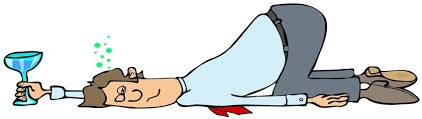

Image result for BLURRING  STAGE IN ALCOHOL CARTOON
THE LEGLESS STAGE


.The deadly phase

If you drink four doubles an hour your blood alcohol level will quickly exceed 0,35 to 0,4 g/100 ml.
With this amount of alcohol in your body your brain will be hit with a vengeance. It's now a matter of life and death: if the alcohol reaches the medulla oblongata (the part of the brain controlling breathing and blood circulation) you can die


THE COMATOSE STAGE


Tuesday, 11 April 2017

AN UNDERWATER PHARMACY

      The oceans cover more than two thirds of Earth's surface, yet we've only dipped our toes in the water when it comes to our understanding of this vast expanse - just 5% has so far been explored
Image result for list of drugs derived from coral reef       Historically, almost all of our drugs from natural sources came from plants and animals that live on land. But recent searches for new drugs have discovered that marine invertebrates (animals without backbones) produce more antibiotic, anti-cancer, and anti-infamma-tory substances than any group of organisms on land. Strangely, many of these substances come from marine animals that spend most of their lives just sitting around the ocean bed.
     Coral reefs are sometimes considered the medicine cabinets of the 21st century. Coral reef plants and animals are important sources of new medicines being developed to treat cancer, arthritis, human bacterial infections, Alzheimer's disease, heart disease, viruses, and other diseases.


Scientists have already developed many medical treatments from resources found in the world’s oceans, For instance:
  • Secosteroids, an enzyme used by corals to protect themselves from disease, is used to treat asthma, arthritis and other inflammatory disorders.
Image result for Secosteroids, plant
  • Bryozoan Bugula neritina, a common fouling organism (similar to barnacles) that’s found in both temperate and tropical climates, is a source for the anti-cancer compound bryostatin 1. The U.S. National Cancer Institute recently collected more than 26,000 pounds of the organism from docks and pilings with little impact on the population.
Image result for Bryozoan Bugula neritina plant
  • Blue-green algae, commonly found in Caribbean mangroves, are used to treat small-cell lung cancer. The National Cancer Institute also endorsed blue-green algae for the treatment of melanoma and some tumors.
 Image result for Blue-green algaeplant
  • Yondelis®, the first new treatment in 30 years for soft-tissue sarcoma, is extracted from the sea squirt, a sac-like filter feeder.
 Image result for Yondelis plant
  • Halaven (eribulin mesylate). Injection is indicated for the treatment of patients with metastatic breast cancer (mBC) who have previously received at least 2 chemotherapeutic regimens for the treatment of metastatic disease.Prior therapy should have included an anthracycline and a taxane in either the adjuvant or metastatic setting. 
 Image result for halaven plant
  •  Tectitethya crypta (formerly known as Cryptotheca crypta) is a large, shallow-water sponge found in the Caribbean.
Many medicines were based on a chemical from the sea sponge Tectitethya crypta. It was first studied for medical purposes in the 1950s when few scientists or doctors thought to look for medicines in the ocean. But in the sponge, scientists isolated two chemicals—aptly named spongothymidine and spongouridine—which were used as models for the development of a number of anti-viral and anti-cancer drugs. These include the HIV drug AZT, a breakthrough in AIDS treatment in the late 1980s, anti-viral drugs to treat herpes, and an anti-leukemia drug. The latter was approved in 1969 and was the first marine-drug approved for cancer treatment.